4.2sr - SRTC Procedure: Work Schedules, Meal and Rest Periods, and Timekeeping
I. PURPOSE:
Southern Regional Technical College (SRTC) follows Technical College System of Georgia (TCSG) Procedure 4.2.1p, Working Hours, Overtime, and Compensatory Time, and TCSG Procedure 4.2.2p1, Official Business Hours and Work Schedules. This procedure establishes SRTC-specific requirements related to official business hours, employee work schedules, alternative work schedules, timekeeping, and other local practices necessary to support the effective operation of the College. Where this procedure is silent, the applicable TCSG procedures govern.
Pursuant to State of Georgia policy and with the exception of a regular, salaried employee working less than full-time (e.g., thirty (30) hours per week) as well as certified law enforcement employees serving in SRTC’s police department, all other, salaried employees of SRTC shall either work, utilize paid leave or holidays, or be placed on authorized or unauthorized leave without pay for forty (40) hours each seven (7) day work week/work period. Work period requirements for certified law enforcement employees are outlined in paragraph VI.E. Within these parameters, the President of SRTC shall establish the official and core business hours for the technical college. The President, or his/her designee, shall ensure that employee work schedules are established to facilitate the effective and efficient operation of the college. Additionally, it is the responsibility of the President to ensure that college operations comply with all applicable provisions of the Fair Labor Standards Act, as well as the State of Georgia policy governing Working Hours, Payment of Overtime, and Granting of Compensatory Time.
II. RELATED AUTHORITY:
SBTCSG Policy 4.2.1: Working Hours, Overtime, and Compensatory Time
TCSG Procedure 4.2.1p: Working Hours, Overtime, and Compensatory Time
SBTCSG Policy 4.2.2: Official Business Hours and Work Schedules
TCSG Procedure 4.2.2p1: Official Business Hours and Work Schedules
III. APPLICABILITY:
All work units associated with Southern Regional Technical College.
IV. DEFINITIONS:
Exempt Employees: Employees who, because of their job duties, are not subject to the minimum wage, overtime and recordkeeping provisions of the Fair Labor Standards Act. Exemptions from the Act are narrowly defined and an employer must prove that the exemption rules apply.
Core Business Hours: The time period during a normal business day that employees working a schedule with flexible starting and ending times are required to be present at work. An example would be core hours from 8:00 a.m. until 5:00 p.m. An employee with these core hours could be permitted to begin his/her workday between 7:00 a.m. and 8:00 a.m. and end his/her day between 5:00 p.m. and 6:00 p.m.
Hours Worked: Generally, all time spent on an employer’s premises or at a designated work place is considered “hours worked” when an employee is required or permitted to perform services of benefit to the employer, except for meal periods of at least thirty (30) minutes (in length) or other periods when the employee is entirely free from duty. Also included as “hours worked” is any work which the employee performs for the employer’s benefit outside of established work hours on or off the employer’s premises (i.e., time spent before, after, or between regular working hours). Unrecorded hours worked during a work week/work period by an employee on or off the employer’s premises must be counted as “hours worked” if the employer knows or has reason to believe that the work is taking place and whether or not the work is performed with the employer’s approval.
Non-Exempt Employees: Employees who are covered by or subject to the minimum wage, overtime and recordkeeping provisions of the Fair Labor Standards Act.
V. ATTACHMENTS:
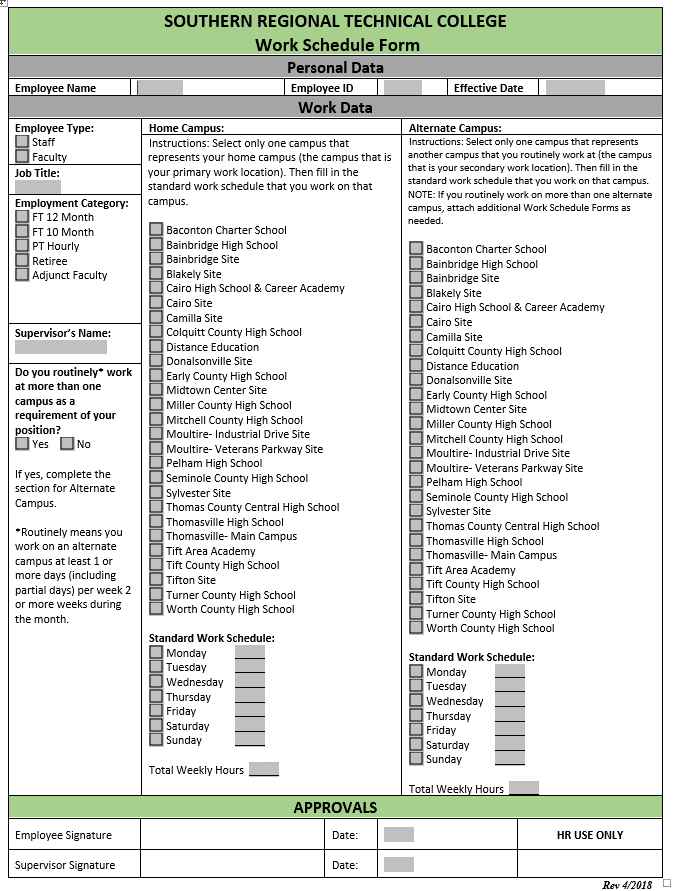
Attachment A: Work Schedule Form
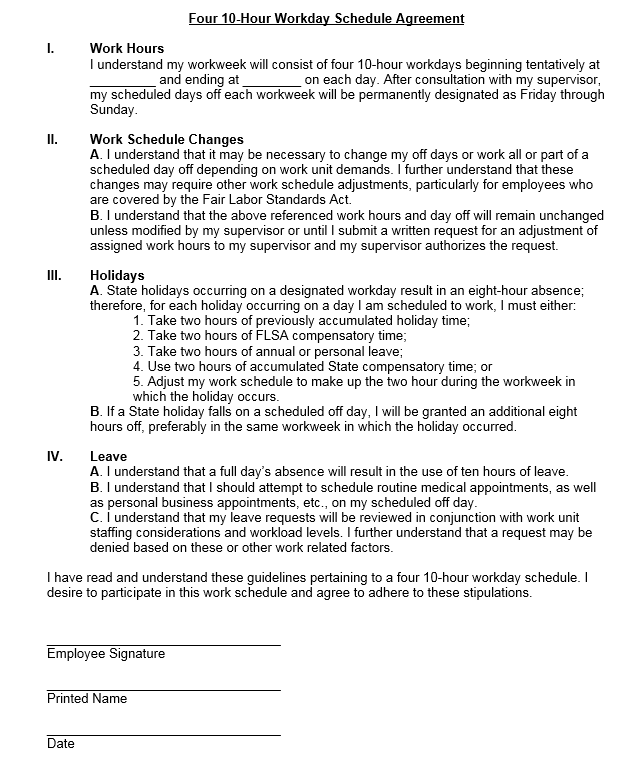
Attachment B: Compressed Workweek Agreement Form
Attachment C: Time Clock Acknowledgement
VI. PROVISIONS:
- Official Business Hours: The campuses of Southern Regional Technical College observe varying hours of operation depending on the location. The five primary campuses (Bainbridge, Cairo, Moultrie, Thomasville, and Tifton) are open Monday-Thursday from 7:30-5:30. The Moultrie Campus is open from 8:00-3:00 on Fridays during Fall and Spring Semesters. Hours at Adult Education sites vary.
- Work Periods and Work Schedules for Non-Law Enforcement Employees:
- The work period for all non-law enforcement employees is a fixed period of seven (7) consecutive calendar days. Work units may establish different work periods for different groups of employees, provided there is a business-related justification. Unless otherwise stated in writing with approval from the President or his/her designee, the work period for all SRTC employees begins at 12:00 a.m. Sunday and ends at 11:59 p.m. Saturday.
- The scheduled work hours of each employee (to include, as applicable, an unpaid meal period and breaks) will be established in conjunction with the needs of the assigned work unit. Managers and supervisors may permit an employee to work desired hours provided the proposed schedule is consistent with college guidelines, work unit operations, and the schedules of other employees. Work schedules may vary from employee to employee dependent upon the type of work performed, work location, and the needs of the work unit.
- Employees may be permitted to work schedules that vary from the college official business hours (i.e., a flexible work schedule) or may request or be required to work a compressed work schedule as outlined below. In all such instances, an employee must be at work during core business hours.
- Participation in an alternative work schedule may be rescinded if there are performance or attendance problems present or other work-related issues as determined by the immediate supervisor or reviewing manager.
- When possible, an employee should be provided advance notice of a modification to his/her established work schedule.
- In addition to a standard work week consisting of five (5), eight (8) hour days, a compressed work schedule incorporates four, ten-hour work days may, at the discretion of a technical college president, be adopted college-wide.
- An employee requesting to participate in a Compressed Work Schedule shall complete an accompanying agreement (i.e., Attachment B). Newly hired full-time employees of the college utilizing a four day, ten hour work schedule should complete Attachment B.
C. Work Periods and Work Schedules for Law Enforcement Employees:
- The work period for all P.O.S.T. certified law enforcement employees serving in SRTC police department shall be established as a fixed period of seven calendar days.
- For each work period, a regular, salaried law enforcement employee must work or use paid leave/holidays for no less than the scheduled amount of hours for the work period. This is equivalent to the number of scheduled work days multiplied by the number of scheduled hours per day.
- The provisions of Paragraph VI.D. and VI.E governing State Holidays and Annual, Sick, or Personal Leave and Compensatory Time are applicable to law enforcement employees whose assigned work day is either nine (9) or ten (10) hours.
D. State Holidays
- Pursuant to State Personnel Board Rules, holidays are valued at eight (8) hours.
- Employees working a nine (9) or ten (10) hour day must either adjust his/her work schedule during the work period in which the holiday(s) occur or, request annual/personal leave or available compensatory time or request placement on authorized leave without pay to make up the one (1) or two (2) hour difference.
E. Annual, Sick, or Personal Leave and Compensatory Time
- Employees working a nine (9) or ten (10) hour day and who are absent from work on approved annual, sick, or personnel leave must request nine (9) or ten (10) hours of leave. Similarly, employees may request an equivalent amount of accumulated FLSA or State compensatory time for such absence(s).
F. Meal Periods:
- Although not mandated by the regulations of the Fair Labor Standards Act or Georgia State Law, and with the exception noted below, all full-time employees will be permitted to take an unpaid meal period as a part of their established work day.
- Meal periods are not considered as “hours worked” provided a non-exempt employee does not perform any work. A meal period must be a minimum of thirty (30) minutes in length but may be longer at the discretion of management.
- Meal periods should be scheduled in a manner that does not negatively impact work unit operations.
- To limit the likelihood of a non-exempt employee performing work during his/her meal period, the employee should not be permitted to occupy his/her work station during the meal period.
G. Breaks:
- Employees may be provided up to two (2) fifteen (15) minute breaks per work day. Breaks are considered as “hours worked” for compensation purposes.
- If the use of formal breaks has been authorized, this time may not be used to lengthen a meal period, report late to work, or leave work early by working through a break period.
- Given that break periods are a privilege for which an employee is compensated, no overtime or compensatory time is earned by an employee who is required to work through one or more break period(s).
- Employees must remain at their work site during a paid break.
H. Timekeeping
- Except as provided in VI.P of this procedure, the time calendar found un GA@Work is the official record of hours worked. NOTE: Additional timesheets or time and effort tracking documents may be required for certain grant or federally funded positions.
- All non-exempt employees and certain exempt employees (i.e. hourly-paid adjunct faculty or full-time employees with additional hourly-paid jobs) are required to keep a timesheet documenting all hours worked in accordance with this procedure.
- Full-time employees must use the absence calendar to account for leave usage or leave without pay.
- Timesheets must reflect the actual starting and ending times the employee works rounded to the nearest five minutes. For example, if the employee begins work at 8:04 a.m., 8:05 must be entered on the timesheet.
- Falsification of actual starting and ending times of work will be considered an attendance and/or conduct infraction subject to disciplinary action.
I. Timekeeping (Use of Electronic Time Clocks)
- By direction of the President or his/her designee, certain job groups, work units, or other position(s) based on a business-related criterion may be directed to use an Electronic Time Clock in addition to the GA@Work time calendar. In these situations, the Electronic Time Clock report is the official record for determining hours worked.
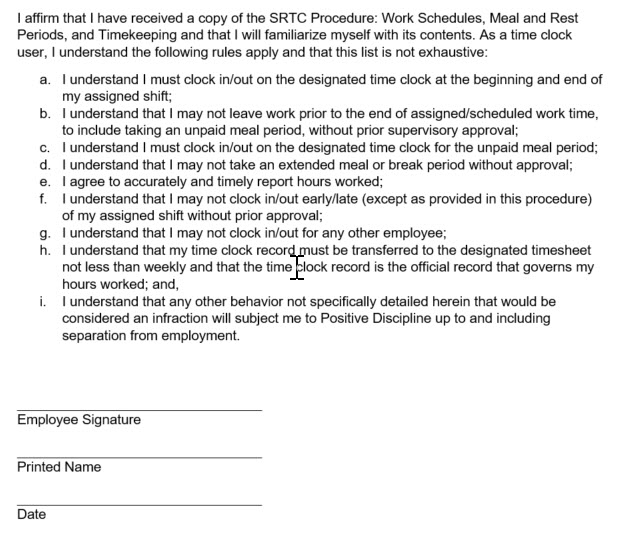
- Electronic Time Clock users are required to sign Attachment C: Time Clock Acknowledgement to acknowledge the rules covering the use of this timekeeping system.
- The Electronic Time Clock must be used for all punches (clock in/clock out) to include starting and ending the work shift, for unpaid meal periods, and for appointments where partial leave is used for the day.
- Electronic Time Clock users may not clock in more than five (5) minutes before their scheduled shift start time.
- Employees who clock in up to two (2) minutes past their scheduled work time will be considered to have clocked in on time.
For example, if the work shift starts at 7:00 a.m. and the employee clocks in at 7:02 a.m., he or she is considered to be on time. If, however, the employee clocks in at 7:03 a.m., he or she is tardy. - At no less than on a weekly basis, the Electronic Time Clock report must be transferred to the aGA@Work time calendar.
- Direct supervisors are responsible for validating that Electronic Time Clock data is correctly transferred to the GA@Work time calendar prior to submission to payroll for processing.
- First time Electronic Time Clock users will be provided a thirty (30) calendar day introductory period for training purposes, beginning on day one (1) of use, to learn the system and to reinforce clock in/clock out behavior. A pattern of missed punches for any reason may be considered an attendance infraction subject to disciplinary action.
J. Management of Work Hours
- Supervisors are responsible for monitoring the arrival and departure times of non-exempt employees and periodically reviewing time records during each established work weekto minimize unplanned and/or unauthorized overtime hours. At the conclusion of each work period/work week, the employee’s immediate supervisor must sign/authorize the time sheet or electronically approve the time record. Part-time hourly timesheets must be approved and submitted on the 15th each month through GA@Work or via paper timesheet as appropriate.
- All non-exempt employees must accurately record all hours worked, meal periods and leave taken daily in GA@Work. Hours worked outside scheduled work hours, including time spent on work-related telephone calls, must be recorded.
- When possible, the work schedule of a nonexempt employee should be adjusted during the work period to avoid overtime.
- Falsification of time records, including the omission of hours worked, will result in disciplinary action.
- FLSA Compensatory Time Accumulation and Recordkeeping:
- Non-exempt employees will be provided one and one-half (1 ½) hours of FLSA Compensatory Time for each overtime hour worked and may accumulate up to a maximum of two hundred and forty (240) hours. Any FLSA Compensatory Time. Time accumulated in excess of this threshold must be delivered as a cash payment.
- Non-exempt law enforcement officers may accumulate up to a maximum of four hundred and eighty (480) hours. Any FLSA Compensatory Time accumulated in excess of this threshold must be delivered as cash payment.
- All accumulated FLSA Compensatory Time shall be recorded in the PeopleSoft HCM.
- Pursuant to FLSA regulations, the following records must be maintained regarding FLSA Compensatory Time:
- The number of hours of compensatory time earned each work week/work period by each employee;
- The number of compensatory time hours used each work week/work period by each employee;
- The number of hours of compensatory time compensated in cash, the total amount paid and the date of the payment; and,
- The written understanding or agreement regarding the earning and using of compensatory time off (obtained at time of on-boarding).
Responsibility
The Vice President of Human Resources has the overall responsibility for ensuring this procedure is implemented.
Reference:
SBTCSG Policy 4.2.1: Working Hours, Overtime, and Compensatory Time
TCSG Procedure 4.2.1p: Working Hours, Overtime, and Compensatory Time
SBTCSG Policy 4.2.2: Official Business Hours and Work Schedules
TCSG Procedure 4.2.2p1: Official Business Hours and Work Schedules
Adopted: 03-06-2018
Implemented: 03-06-2018
Revised: 09-18-2019
Attachment A: Work Schedule Form
Attachment B: Compressed Workweek Agreement Form
Attachment C: Time Clock Acknowledgement